


The short answer
Most cooktop problems, such as burners that won't ignite, constant clicking, weak flames, dead elements or induction error codes, come down to a specific part that can be tested and replaced. On a high-end Wolf, Viking or Thermador cooktop, repair is usually the practical choice unless the glass top is cracked, the burner box is corroded, or parts are no longer available.
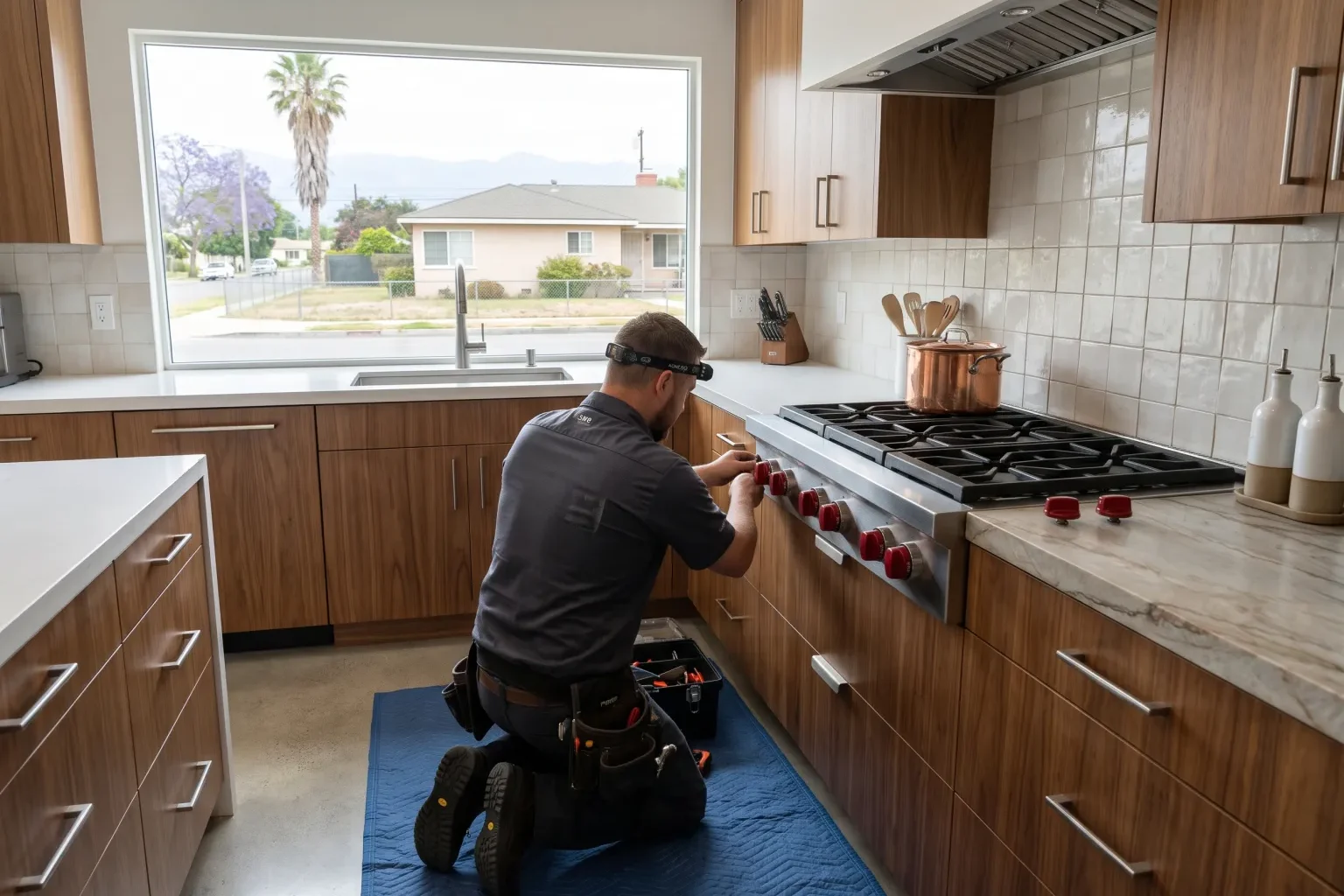
A cooktop that won't light, clicks nonstop or throws an error code can stop dinner in its tracks. Wolf Repair Experts repairs built-in and professional-style cooktops and rangetops in Woodland Hills and nearby communities, including Tarzana, Encino, Calabasas, West Hills and Canoga Park. We work on Wolf first and foremost, along with Viking and Thermador, and we service the Sub-Zero refrigeration that often sits in the same kitchen. We are an independent repair company and not affiliated with any manufacturer. This page explains the problems we see, what a technician checks, how the brands differ, and how to decide whether a repair makes sense.
Issues we fix
Cooktop failures tend to show up in a few recognizable ways. Make a note of what you see and hear before the visit. A detail like "it clicks only after I wipe the top" can point straight to the cause.
If you smell gas, turn the burners off, don't use switches or flames, leave the house and call your gas utility. A repair visit comes after the gas line is confirmed safe.
- Gas burners that won't ignite, or light only after several tries
- Igniters that keep clicking after the burner lights, or click when the knob is off
- Yellow, lifting, uneven or weak flames
- Burners that won't hold a low simmer or go out on the lowest setting
- Electric or radiant elements that stay cold or won't shut off
- Induction zones that don't detect the pan, cut out mid-cook or show error codes
- Touch controls that don't respond, beep constantly or lock up
- Uneven heat across a griddle, French top or large burner
- Cooling fan noise or a fan that runs long after cooking
- Cracked or chipped glass, loose knobs and worn bezels
What our technician checks on a built-in or professional-style unit
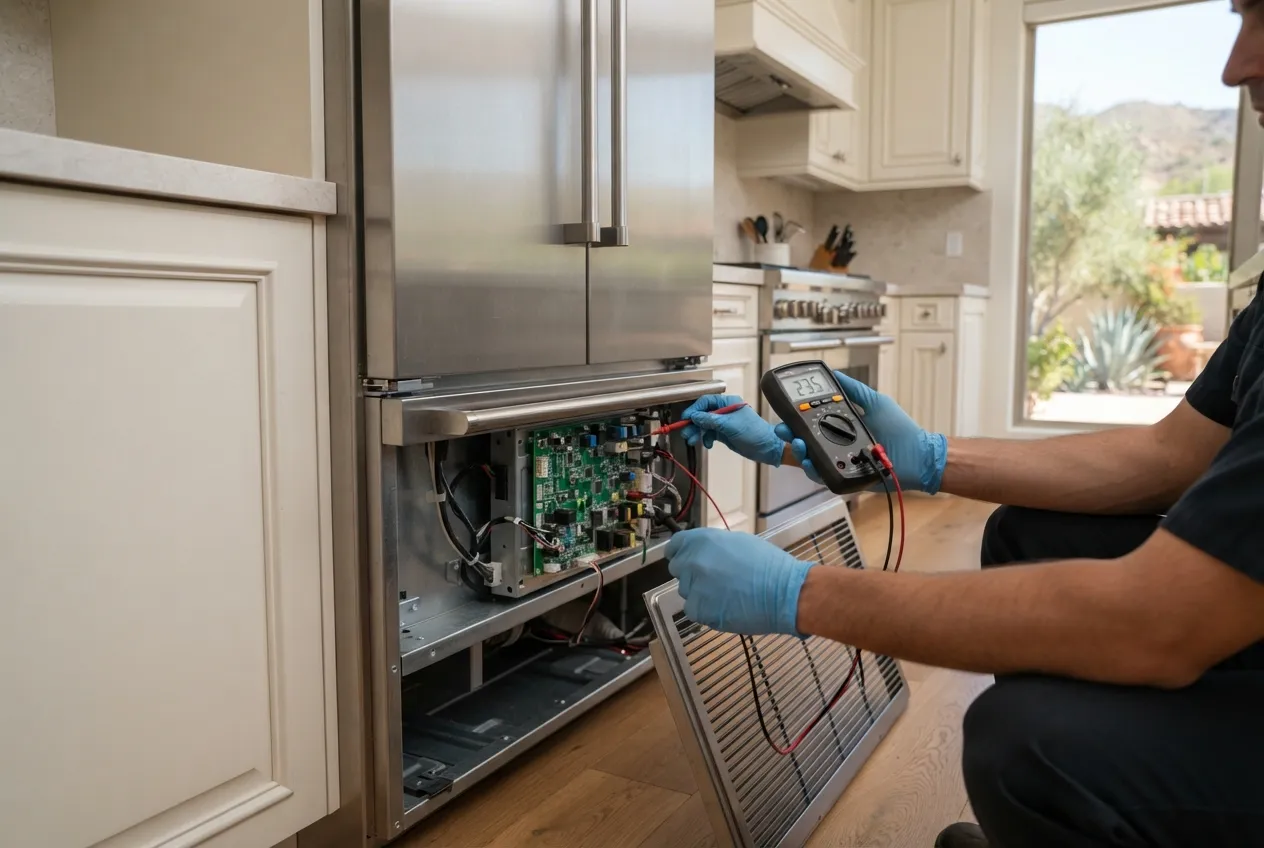
We start by confirming the complaint with the unit running, then work from the simplest causes to the more involved ones. On a gas cooktop or rangetop, that means checking burner caps and heads for alignment, cleaning and gapping the electrodes, measuring spark output, and testing the spark module and the spark switches behind each knob. Moisture from boil-overs or cleaning is a common reason for continuous clicking. We also check flame quality, look at the burner valves and orifices, and confirm the unit is set up for the right gas type.
On electric and radiant units, we test the elements, the infinite switches or electronic controls, the wiring and the limiters. On induction cooktops, we read stored error codes, test the cooling fan and the airflow path under the counter, and check the power and control boards and the induction coils. Blocked ventilation inside the cabinet is a frequent cause of induction shutdowns, especially in kitchens that get hot in Valley summers. We also look at how the unit sits in the cabinetry, because a cooktop that can't breathe or is wired to an undersized circuit will keep failing even after a good part goes in.
How Wolf, Sub-Zero, Viking and Thermador cooktops differ
Wolf gas cooktops and rangetops use sealed, dual-stacked burners that go from a high flame down to a very low simmer. That design depends on clean ports and properly seated burner parts. When owners report a simmer that blows out or a burner that won't relight, we look first at the electrodes, the spark switches and the burner assembly. Wolf also makes induction and electric cooktops, where control and fan issues are more typical. Wolf and Sub-Zero belong to the same company, and Sub-Zero itself builds refrigeration rather than cooktops. Many kitchens pair the two, so we can look at a Sub-Zero refrigerator on the same visit when it's needed.
Viking cooktops and rangetops are built for high output. On gas models, worn spark switches, igniters and burner valves are the usual culprits, and high heat over the years can wear knobs and grates. Thermador gas cooktops use the Star burner and automatic reignition, so a sensing or spark module fault can show up as constant relighting or clicking. Thermador induction models are more likely to show electronic and fan-related errors. Knowing these patterns helps us bring the right parts and diagnose faster, but we always test before we replace.
Tell us what your appliance is doing.
Repair or replace a high-end cooktop
Premium cooktops are built to be serviced, and most common failures involve parts like igniters, switches, valves, fans or control boards that can be swapped without removing the unit. Replacing a built-in cooktop also brings other costs. A new model may not match the cutout in your stone counter, it may need different gas or electrical connections, and it may not line up with your hood or backsplash.
Replacement starts to make sense when the glass top is badly cracked on an older unit, the burner box or chassis is corroded, several major components have failed at once, or the manufacturer no longer supplies the parts. If you're thinking about a remodel anyway, we'll tell you plainly whether a repair is worth doing in the meantime.
What affects the cost of a cooktop repair
We don't quote a price until we've diagnosed the unit, because the same symptom can have very different causes. Constant clicking might be fixed by drying and cleaning the electrodes, or it might need a new spark module.
The main factors are the fault itself, the parts involved (a spark switch is a much smaller job than an induction power board or a glass top), parts availability for your model, and access. Cooktops set into custom cabinetry, under-counter downdraft systems or tight islands can take longer to reach safely. After diagnosis we explain what failed and what we recommend, and we give you the cost before any repair starts.
How a visit works
When you contact us, have the brand, model and serial number ready if you can. They're usually on a tag under the cooktop, on the burner box or in the owner's manual. Tell us the symptoms and when they started. We'll schedule a visit and ask that the cooktop be cool and the surface clear when the technician arrives.
On site, the technician confirms the problem, runs the checks described above and walks you through the findings. If the part is on the truck, we can often finish the repair the same visit. If it has to be ordered, we schedule a return trip once it arrives. Before leaving, we test every burner or zone, check flame quality or heating response, and show you anything you can do to prevent a repeat, such as how to seat burner caps or keep induction vents clear.
Cooktop Repair by city
-
 Cooktop Repair in Hidden Hills
Local service & repairs
-
 Cooktop Repair in Calabasas
Local service & repairs
-
 Cooktop Repair in Agoura Hills
Local service & repairs
-
 Cooktop Repair in Simi Valley
Local service & repairs
-
 Cooktop Repair in Santa Monica
Local service & repairs
-
 Cooktop Repair in Westlake Village
Local service & repairs
-
 Cooktop Repair in San Fernando
Local service & repairs
-
 Cooktop Repair in Beverly Hills
Local service & repairs
-
 Cooktop Repair in Malibu
Local service & repairs
-
 Cooktop Repair in West Hollywood
Local service & repairs
-
 Cooktop Repair in Los Angeles
Local service & repairs
-
 Cooktop Repair in Thousand Oaks
Local service & repairs