
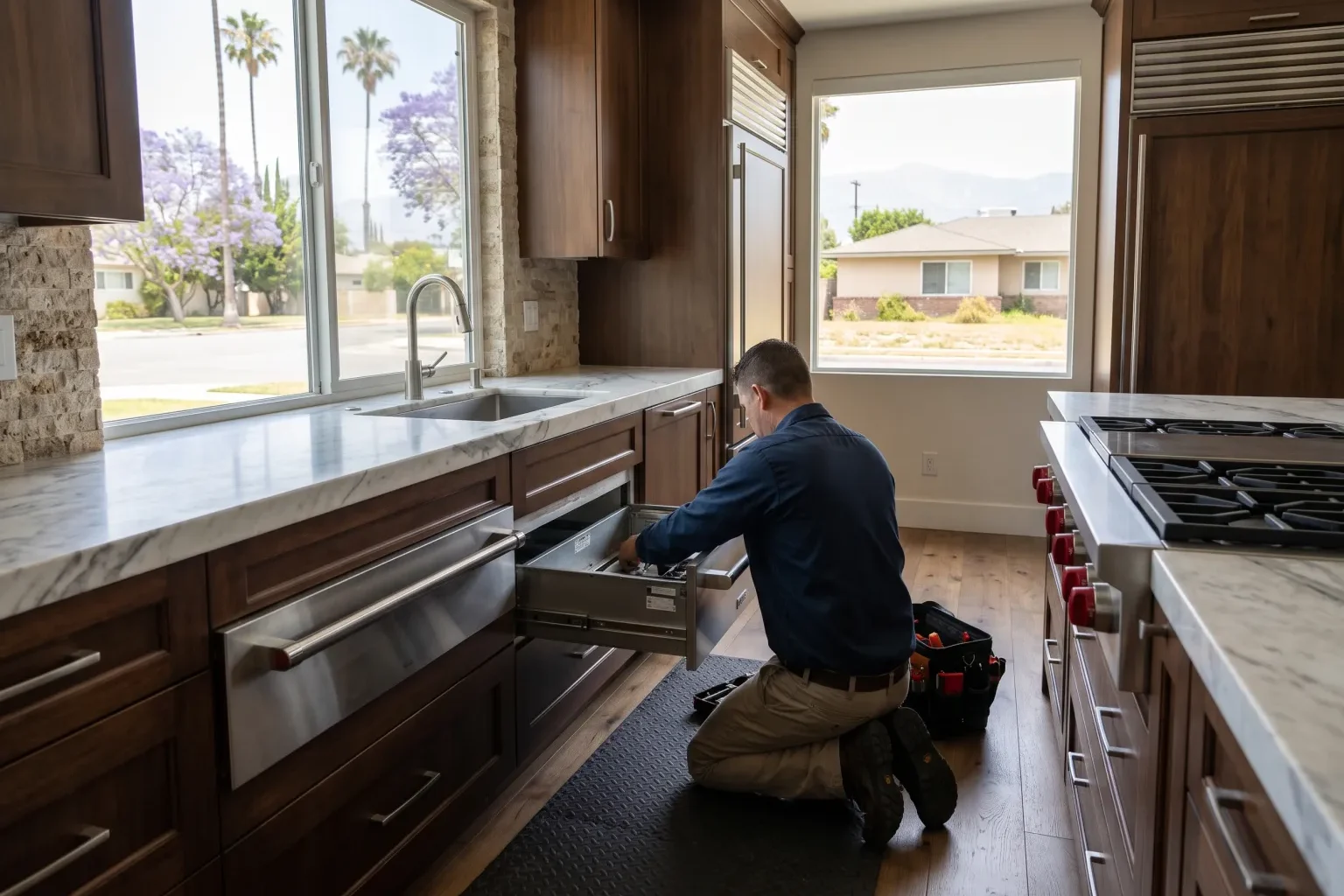



The short answer
Most warming drawer problems come from a heating element, temperature sensor, thermostat, control board, door seal or drawer slides, and nearly all of them can be repaired. On a built-in premium unit, repair is usually the better choice than replacement, because a new drawer has to match the cutout, trim and panel of your existing cabinetry.
A warming drawer has one job: hold plates and food at a steady serving temperature without drying them out. When it stops heating, runs hot, or won't close properly, the problem is usually a specific part, not the whole unit. Wolf Repair Experts repairs built-in warming drawers from Wolf, Viking and Thermador. We also service the Sub-Zero refrigeration they often sit beside. We work with homeowners in Woodland Hills, Calabasas, Tarzana, Encino, West Hills and surrounding San Fernando Valley communities. We are an independent repair company and are not affiliated with or endorsed by any appliance brand.
Issues we fix
These are the warming drawer complaints we hear most often. If you notice one of them, stop using the drawer for food until it's checked. This matters most if it's running hotter than the setting or you smell something burning.
- Drawer doesn't heat at all, or the indicator light is on but the cavity stays cold
- Food comes out lukewarm, or the temperature drifts away from the setting
- Drawer runs too hot and dries out or keeps cooking food
- Uneven heat, with one side or the back warmer than the front
- Controls don't respond, settings won't hold, or the display shows an error
- Breaker trips or the drawer cuts out shortly after it turns on
- Moisture or humidity setting doesn't seem to change anything, leaving food soggy or dried out
- Drawer sticks, grinds on its slides, or won't close fully
- Door gasket is torn, flattened or loose, letting heat escape
- Burning, hot-plastic or electrical smell during use
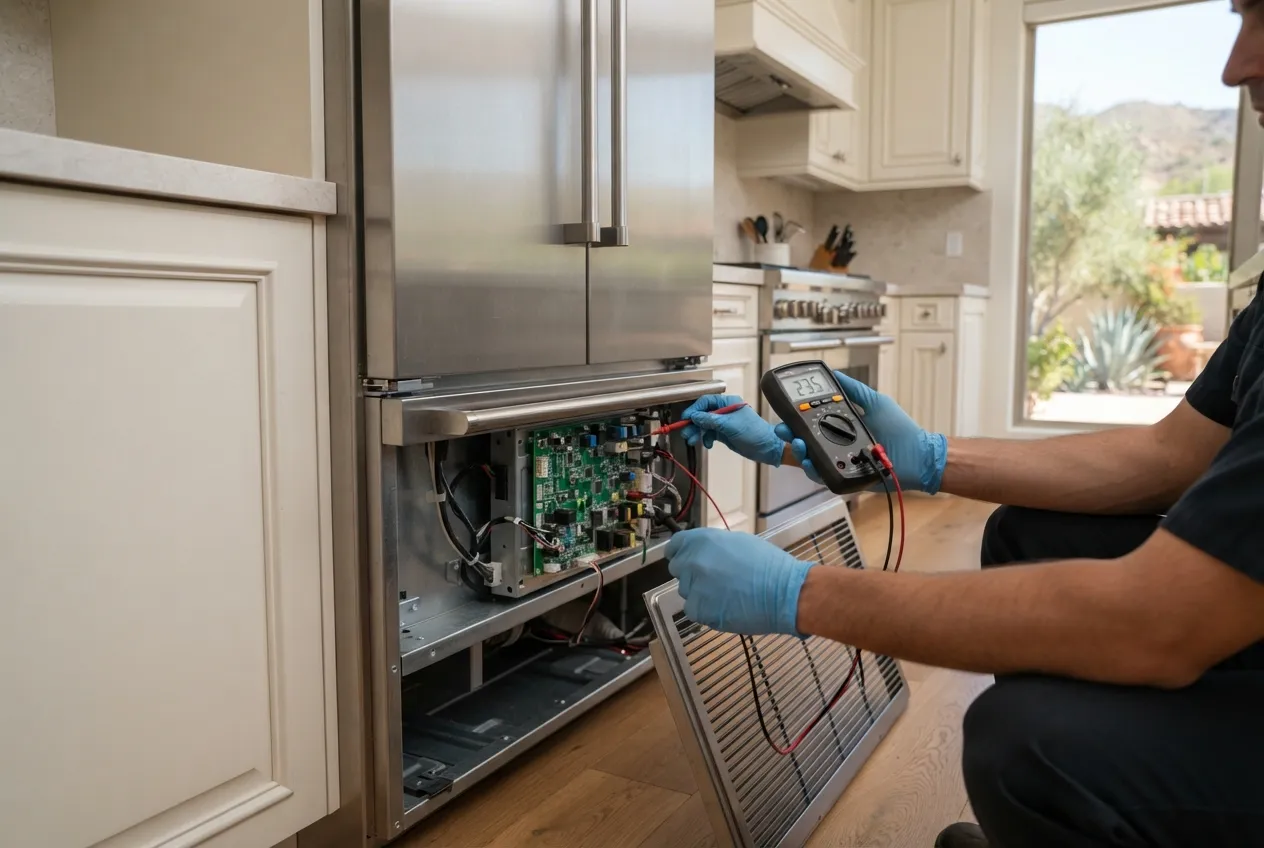
What our technician checks on a built-in or professional-style drawer
We start with power. Many warming drawers run on a dedicated circuit, so we confirm the drawer is getting the correct voltage before testing anything inside it. Then we check the heating element for continuity and look for signs of breakdown, such as discoloration or a broken coil. We also test the temperature sensor or thermostat against an actual reading of the cavity, since a drawer can heat perfectly and still be controlled by a sensor that reads wrong.
Next we look at the controls: the touch panel or knob, the control board, and the wiring connections between them. Heat cycling over time can loosen terminals or darken connectors, and that shows up as intermittent heating. Most drawers also have a thermal cutoff or high-limit safety device. When that has opened, we want to know why, not just replace it.
Finally, we check the mechanical side. That means the door gasket, the drawer slides and their mounting, the moisture vent or humidity control, and how the drawer sits in its cutout. A drawer that doesn't seal or close squarely loses heat no matter how healthy the electrical parts are.
How Wolf, Sub-Zero, Viking and Thermador drawers differ
Wolf warming drawers are often installed under a Wolf wall oven or beside a range. They commonly include a moisture-control setting along with temperature control. Beyond the usual element and sensor faults, we look at the controls and the vent mechanism that manages humidity, because owners often report food drying out when the real issue is the vent or the seal.
Sub-Zero is a refrigeration brand, so in most Sub-Zero kitchens the warming drawer is a Wolf unit. We service both. If you're scheduling a Sub-Zero refrigerator or wine storage repair, mention the drawer, and we can look at both in the same visit when that's practical.
Viking warming drawers come in a range of sizes and finishes, and many have mechanical or simpler electronic controls. On these, a worn thermostat, a failed element, or tired slides on a heavily used drawer are common findings. Thermador drawers are usually sleek, flush-mounted units, and some use push-to-open or panel-ready designs. Their electronic controls and the alignment of the drawer front within the cabinetry get extra attention during our inspection.
Tell us what your appliance is doing.
Repair or replace a high-end warming drawer?
For most premium warming drawers, repair makes sense. The parts that fail are individual components: an element, a sensor, a control board, a gasket or a set of slides. The cabinet, insulation and frame usually outlast them by a wide margin.
Replacement deserves a look when the drawer has several failing parts at once, or when the cavity or frame is damaged. It also makes sense if a critical part is no longer available, or if you're remodeling anyway. Keep in mind that a replacement drawer has to fit the existing cutout and match your trim or custom panel. Sometimes that means cabinetry work, which is part of the real cost of replacing. We'll tell you plainly which way we'd lean and why.
What affects the cost of a warming drawer repair
We don't quote before we've diagnosed the drawer, because the same symptom can have very different causes. These are the factors that drive the total:
- The fault itself: a loose connection or gasket is a smaller job than a control board or element replacement
- Parts: genuine replacement parts for premium brands vary in cost and availability, and some need to be ordered
- Access: a drawer in custom cabinetry, with a custom panel or tight surrounding trim, can take more time to remove and reinstall safely
- Related issues: a tripped high-limit or scorched wiring may point to a second problem that should be fixed at the same visit
- Whether more than one appliance is being serviced on the same trip
How a service visit works
When you contact us, tell us the brand, the model number if you can find it, and what the drawer is doing. The model plate is often on the drawer frame, visible when the drawer is pulled fully open. We'll schedule a visit at your home in Woodland Hills or a nearby city.
At the appointment, the technician confirms the symptom, runs the checks described above, and explains what failed. You'll get a clear recommendation before any repair begins. If the part is on the truck, we can often finish the same day. If it has to be ordered, we'll schedule a return visit to install it. Before we leave, we test the drawer to confirm it heats, holds temperature and closes properly. We'll also point out anything else we noticed, such as a gasket that's close to wearing through.