



The short answer
Most ice maker problems on high-end refrigerators and undercounter units trace back to the water supply, the inlet valve, a frozen fill tube, the ice maker module, or a drain issue. These faults are usually repairable at the part level. Replacing a built-in unit only makes sense in a few situations.
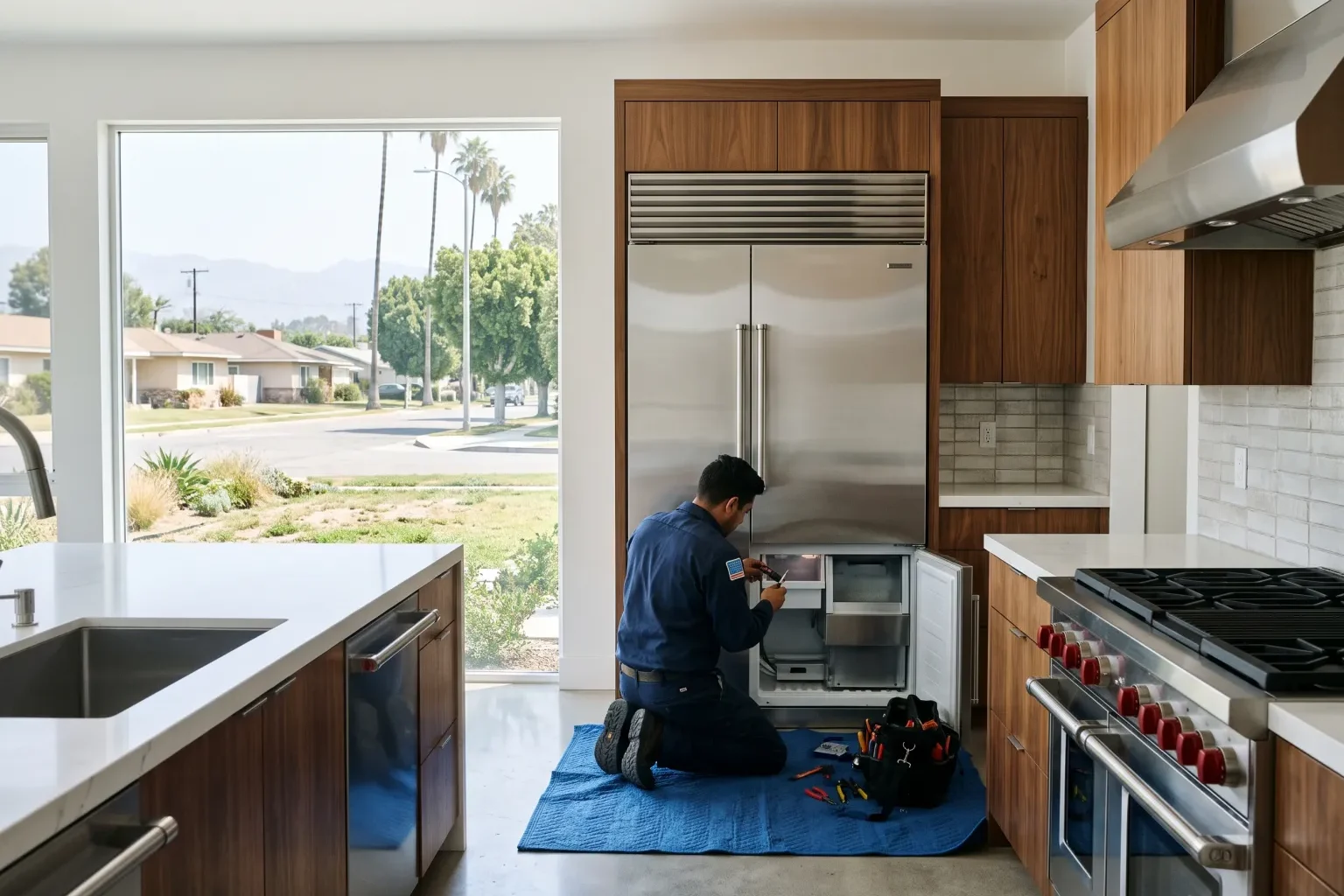
A built-in refrigerator that stops making ice is a small problem until you need ice every day. Most ice maker failures come down to a specific part or a water supply issue, not a failing refrigerator. Wolf Repair Experts repairs ice makers in Woodland Hills and nearby cities. We work in kitchens built around Wolf cooking equipment and service the ice makers in Sub-Zero, Viking and Thermador refrigerators, along with freestanding undercounter ice machines. We are an independent repair company. Our goal is to find the actual cause, explain it plainly, and fix it without guesswork.
Issues we fix
Ice makers tend to fail gradually. The cubes shrink first, or the bin fills more slowly, before production stops completely. If you notice any of the following, it is worth having the unit looked at before a small leak or a frozen line turns into a bigger repair.
- No ice at all, even though the refrigerator and freezer are cold
- Small, hollow, or misshapen cubes
- Ice that clumps or freezes into a solid block in the bin
- Water leaking into the freezer, onto the floor, or into the cabinetry below
- An undercounter ice machine that isn't draining or has standing water in the bin
- Frost or ice build-up around the fill tube or ice maker assembly
- Cloudy, off-tasting, or slow-producing ice
- Clicking, buzzing, or grinding when the ice maker tries to harvest
- Error codes, flashing lights, or a dispenser that won't respond
- An ice maker that keeps up in mild weather but falls behind in summer heat
What our technician checks on a built-in unit
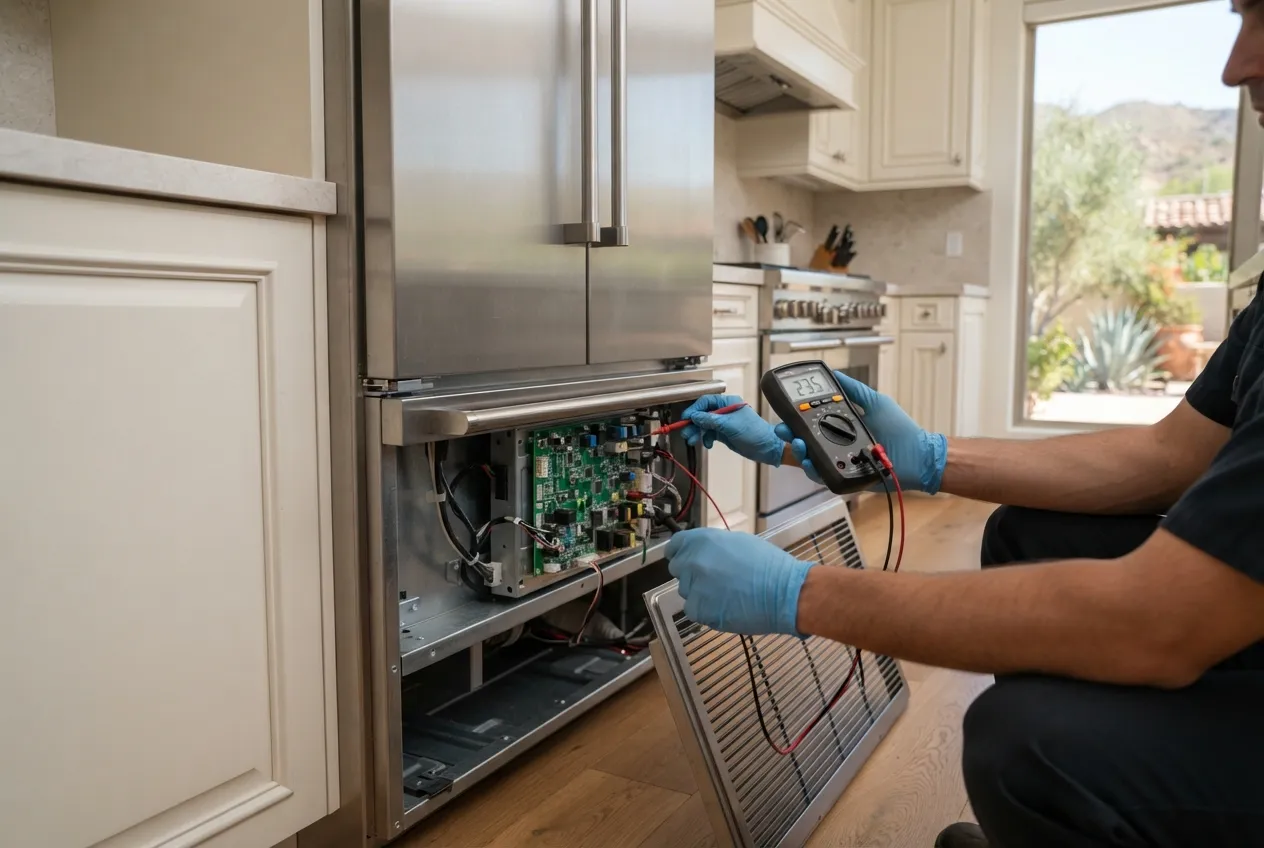
We start with the water, because many no-ice calls are really supply problems. The technician checks the shutoff valve, the supply line, and the water pressure reaching the unit. They also look for kinks or crushed tubing behind the panel or in the cabinet. A clogged or overdue water filter can reduce flow enough to produce small cubes or none at all, so we check that too.
Next comes the refrigerator itself. We confirm the freezer is holding the right temperature. An ice maker in a freezer that runs too warm will cycle slowly or not at all. We test the water inlet valve and inspect the fill tube for ice blockage. Then we run the ice maker through its cycle to check the thermostat or sensor, the harvest motor, and the bin-full arm or sensor. Many built-in models have a diagnostic mode, so we read any stored codes before replacing anything.
On undercounter ice machines, we also check the drain line and drain pump, the water distribution system, and the condenser. These units breathe through a front grille at the toe kick. Dust and lint there can cut ice production noticeably, especially in a hot kitchen. Woodland Hills and the rest of the San Fernando Valley run much hotter in summer than areas near the coast, and an ice machine with poor airflow feels that first.
How the brands differ
Wolf is a cooking brand, so its ranges, cooktops and wall ovens don't make ice. In many local kitchens, though, a Wolf range sits a few feet from a Sub-Zero column or an undercounter ice machine in the same custom cabinetry. We work around those installations carefully.
Sub-Zero built-in refrigerators use an ice maker in the freezer compartment that relies on a steady water supply and a properly cold freezer. Sub-Zero undercounter ice makers, including models designed to produce clear ice, work differently. They freeze water as it flows over a chilled surface, so mineral scale, water distribution, and drainage matter more. Viking built-in and freestanding refrigerators and Viking undercounter ice machines share the common failure points: inlet valves, ice maker modules, dispenser components, and drains on the undercounter models. Thermador column refrigerators often hide their water lines behind panels and inside tight cabinet runs. On those units, supply-line routing and filter condition deserve a close look alongside the ice maker itself.
Tell us what your appliance is doing.
Repair or replace?
High-end built-in refrigerators are designed for long service. They are also sized to a specific opening and often wear custom panels that match your cabinetry. Replacing one means finding a unit that fits that opening and adapting the panels, which can turn into a larger project than most people expect. An ice maker failure, by contrast, is usually a part-level repair: a valve, a module, a sensor, or a drain component.
Replacement is worth discussing in a few cases. These include a sealed-system failure on an older refrigerator, parts that are no longer available, or a unit with repeated problems across several systems. For freestanding undercounter ice machines, the math is closer, and we'll tell you plainly when a repair doesn't make sense.
What affects the cost
We don't quote over the phone without knowing the fault, because the range of possible causes is wide. A clogged filter or a kinked line is a very different job from a failed control board.
The main factors are the fault itself and the parts it needs, including whether those parts are in stock or need to be ordered. Access also matters. A fully integrated refrigerator in custom cabinetry may need panels removed, or the unit carefully pulled from its opening, to reach the water connection or the back of the ice maker. Finally, whether the repair can be finished in one visit or needs a return trip after parts arrive affects the total. You will hear the diagnosis and the options before any repair work begins.
How a visit works
When you contact us, tell us what you're seeing and, if you can, the model and serial number. On most built-in refrigerators, these are on a label inside the compartment or behind the top grille. That helps the technician arrive prepared.
At the visit, the technician diagnoses the problem, explains what failed and why, and walks you through your options. If the part is on hand, the repair can often be done the same day. If not, we order it and schedule the return. After the repair, we run a fill and harvest cycle to confirm the ice maker is working. We'll also mention anything you can do to keep it running well, like changing the filter on schedule or keeping the toe-kick grille clear.